TikTok has taken a big step in their advertising journey this week with the launch of TikTok Pulse, a new contextual advertising solution that lets advertisers place their brand next to top content. TikTok offers 12 categories of Pulse in which brands can place their ads next to the most culturally relevant content. The categories include beauty, fashion, gaming, and cooking.
Brand safety is clearly top of mind for the platform. TikTok’s press release promises advertisers “our highest level of brand suitability applied on the platform” and third party brand suitability and viewability verification. The ad spots can be purchased via TikTok’s self-serve ad management platform. Like any good ad platform, advertisers will receive post-campaign audience reporting.
At the same time, the platform is developing a more businesslike relationship with its top creators. Pulse will see TikTok offer revenue sharing for the first time, similar to payment models available on YouTube and Facebook.
TikTok exploded in popularity during the pandemic, reaching 1 billion monthly active users. By the end of 2021, it was viewed more often than Google.
DanAds has previously reported on the huge opportunity for monetising user-generated content (UGC) through self-serve advertising. The bottom line is this: the way we consume media is no longer a top-down process. Compared to television, radio and print, UGC is a much more dynamic media consumption where the audience is highly engaged. The users themselves are active participants in the creation, critique and dissemination of content.
TikTok’s strength as an ad space provider comes from that interdependent relationship with its creator base. Their users are constantly creating huge quantities of content around topical and niche subjects. That content is an ideal opportunity for advertisers to engage in contextual campaigns, and build close relationships with their target audiences.
It’s no surprise that social and digital advertising continue to eat away at market share from traditional media. The old way of selling advertising is quickly becoming too outdated, expensive, and ineffective to survive. Learn more about the future of digital advertising.
In the third week of April 2022, more than 14,000 small businesses hosted by the popular e-commerce platform Etsy went on strike, closing their (virtual) doors to customers. Less than two months earlier, the company had reported record revenues and shares at an all time high. So what happened? The strike was triggered by Etsy raising seller transaction fees by 30% – but that was just the tip of the iceberg. In this blog we discuss what the Etsy strike tells us about small business and Big Tech.
How Etsy sees their sellers
“Each of our sellers is a blade of grass in a tornado. They’re someone you haven’t heard of.†That’s how Etsy CEO Josh Silverman described the company’s more than 4 million small businesses in a recent interview with The Wall Street Journal, responding to the week-long seller strike. According to him, Etsy sellers have little chance of turning a profit on their own – and that’s where Etsy’s brand and marketing comes in. Etsy spent more than $500 million on advertising last year and plans to increase that spend this year. The company acts as an umbrella for individual sellers; users trust the Etsy brand, and are able to find products they want through the site’s search engine. In other words, Etsy provides a service – and the small businesses are its customers.
What caused the strike
The seller strike, triggered by the company hiking transaction fees from 5% to 6.5%, saw at least 14,000 businesses close shop and more than 80,000 people sign a petition demanding changes. One of the five demands was for Etsy to give all sellers the ability to opt out of off-site ads. Etsy, as part of its marketing strategy, creates and operates ads for their sellers all across the internet. The kicker is that the seller has no say in how and where the ads are placed, or the content of the creative. But if a sale is made through the ad, then Etsy passes the cost to the seller – and there’s no way to opt-out.
Etsy, in short, is prioritising their own goals over those of their sellers. Small businesses deserve the chance to build and execute their own strategy, particularly with regards to digital advertising. That’s what this strike was about: small businesses operating on their own terms.
Why small business advertising matters
In the last year alone, digital ad spend grew by an unprecedented $2bn, and that was largely driven by small businesses, not large corporations. Amazon, Facebook, and Google have all built enormous digital empires by giving SMEs the opportunity to advertise with more control. Etsy seems to have missed that crucial point.
One of the many reasons that control over off-site advertising matters to Etsy sellers is brand safety. Businesses of all sizes are increasingly cautious about where their ads are shown. In a recent study, 41% of US businesses listed brand safety as one of the issues posing the greatest threat to their marketing. It’s completely unreasonable for Etsy to place ads without input from the businesses whose products they’re promoting, and exposes their sellers to potentially inappropriate contexts and associations.
With the explosive rise of self-serve advertising platforms – adopted by the likes of Spotify, Soundcloud, Roku, Tripadvisor, Bloomberg and more – there’s no excuse to take such a top-down approach to marketing.
Etsy: give your businesses control over their own advertising. Otherwise, they’ll find a partner who will.
It’s been a bad week for Netflix. After reporting a loss of subscribers – for the first time in 10 years – the company’s share price tanked by 25%. The company blamed a number of factors; withdrawing their services from Russia cost them 700,000 users, new competitors like Disney+ and HBO are fighting for market share, and subscribers sharing passwords is apparently a huge problem now.
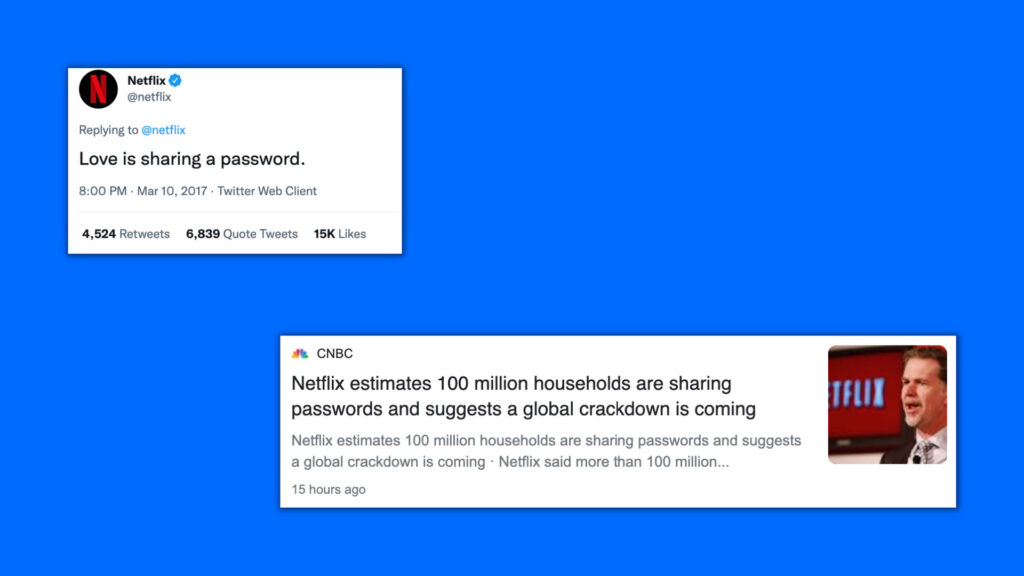
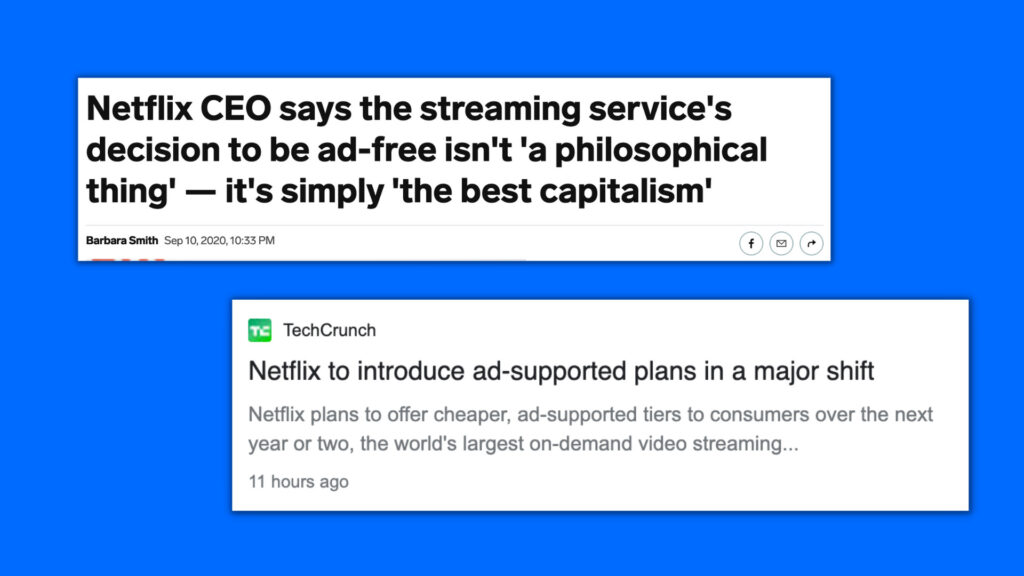
In response, Netflix broke with years of protocol and announced plans for ad-supported streaming subscriptions, citing Hulu and Disney as evidence that it works.
“Those who have followed Netflix know that I have been against the complexity of advertising, and a big fan of the simplicity of subscription,” said the company’s co-CEO, Reed Hastings. “But as much as I am a fan of that, I am a bigger fan of consumer choice. And allowing consumers who would like to have a lower price, and are advertising-tolerant, get what they want, makes a lot of sense.”
This is a huge u-turn for the platform. Only recently, Netflix said “There’s much more growth in the consumer market than there is in advertising… We believe we will have a more valuable business in the long term by staying out of competing for ad revenue and instead entirely focusing on competing for viewer satisfaction”.
So what happens now? We asked Johan Liljelund, CTO and EVP of self-serve adtech company DanAds.
“Netflix’s plans for ad-supported streaming won’t incite a return to the days of constant ad breaks and linear TV. Rather, the future of ad-supported streaming lies in creating a flexible middle ground where consumers can choose from a selection of price models: subscription, ad-supported, or a hybrid of both. For OTT providers, offering only subscription models means that they price themselves out of the market for cost-conscious cord cutters. But as competition stiffens and consumer choice reigns supreme, they must acknowledge that consumers are increasingly looking for flexible, low-cost alternatives to meet their streaming needs.
The ad-supported model has reached a level of maturity that makes it impossible for streaming giants to overlook the benefits. And thanks to Netflix, these benefits will now take centre stage, including the ability to generate new revenue streams and innovate the user ad experience to make it more effective and less obnoxious. What’s more is that the technology to deliver these benefits has become more robust, using a combination of white-glove and programmatic ad sales, as well as self-serve advertising platforms that allow OTT providers to sell their ad inventory through a branded, automated marketplace. This enables them to tap into the massive SME ad spend that currently drives digital ad growth.”
Working in digital advertising means always having one eye on the future. It’s not enough to play by today’s rules; a good advertiser or publisher knows that the landscape can change quickly. Failing to prepare is preparing to fail. To help you stay in the loop, we’ve summarised some of the most important regulatory changes and proposals in the digital ads industry.
1. Bill to Ban Surveillance Advertising (US) calls to end targeted advertising with personal data
In January, Congresswomen Anna G. Eshoo (D-CA) and Jan Schakowsky (D-IL) and Senator Cory Booker (D-NJ) introduced the Banning Surveillance Advertising Act, legislation that prohibits advertising networks and facilitators from using personal data to target advertisements. The bill calls targeted advertising “surveillance advertising†and calls for the wholesale prohibition of most industry standard aspects of digital advertising, such as targeting based on user demographics.
“Surveillance advertising is a predatory and invasive practice. The hoarding of people’s personal data not only abuses privacy, but also drives the spread of misinformation, domestic extremism, racial division, and violence,†said Senator Booker. “With the introduction of the Ban Surveillance Advertising Act, advertisers will be forced to stop exploiting individuals’ online behaviour for profits and our communities will be safer as a result.â€
There is very little chance that the bill will pass, but its proposal should be taken as an indicator of growing political momentum against the current state of online advertising.
2. IAB cookie consent framework, widely accepted until now, deemed a GDPR violation by Belgian DPA
Since the introduction of GDPR regulation in 2018, publishers and advertisers alike have struggled to adapt to the new rules around data protection and privacy. For a while, the Transparency and Consent Framework (TCF) created by IAB Europe was the gold standard for the industry, promising a simple structure for GDPR compliance.
The industry let out a collective groan of frustration, therefore, when in February 2022 the Belgian Data Protection Agency (DPA) fined IAB Europe €250,000 and ordered it to make a corrective action plan within two months. Just like that, a framework that was used by pretty much every major player in Europe was suddenly declared invalid.
Luckily for publishers, the IAB’s TCF remains completely lawful for users to use, and data collected would only be unlawful if collected by any publisher in breach of the minimum standards of the GDPR – as was always the case. The onus is on the IAB to refine and reform their TCF.
3. UK government eyes stricter regulation and higher publisher responsibility for ads under proposed Online Safety Bill
The UK Government recently released their Online Advertising Programme consultation, in connection with their proposed Online Safety Bill. The consultation notes that the rapid growth of online advertising carries the risk of “illegal fraudulent adverts and legal but harmful advertsâ€.
The key phrase here is the highly controversial “legal but harmfulâ€, a central point in the proposed bill. Under new rules, publishers would be held responsible for content – including ads – even when it does not break the law. Failure to remove harmful content will be punished with heavy fines. As noted by several campaign groups, the Government has stopped short of explicitly defining “harmfulâ€. Jim Killock, Executive Director of digital rights organisation Open Rights Group, has said that the legislation will lead to “overreaction and content removalâ€.
The potential impacts on free speech aside, this legislation (if passed) will encourage publishers and advertisers to err heavily on the side of caution in ad approval and removal. With publishers given greater responsibility to moderate the ads published on their platforms, coupled with a vague and shifting definition of harmful content, we can expect more stringent approval processes for ad creatives. This may prove especially challenging for social platforms that handle a large volume of low-budget ads without a manual approval process.
Ready to see what a self-serve platform can do for your business? Let’s talk!
Johan Liljelund, CTO and EVP at DanAds, comments: “At DanAds we’re in favour of a transparent and open digital economy. Regulation can have both positive and negative effects on consumers and businesses – many of which are unintended. Publishers have a responsibility to ensure that the ads they host are compliant with local laws, which can sometimes be a challenging task when balanced with an increasing degree of automation. In fact, in today’s programmatic landscape it’s almost impossible for a publisher to have that full brand safety control.
That’s why we, at DanAds, put a lot of focus on streamlining and automating the creative process both for the advertiser, through easy to use templates, and for the publisher through automated technical and visual screening. We always include a manual approval option in our self-serve campaign platforms, and encourage our publishers to be proactive about choosing approved partners. It’s always better to prevent a problem before it happens than to try to fix it after the fact.â€
Peo Persson is the co-founder and EVP of Sales at DanAds, the leading Swedish adtech scaleup. The company has seen rapid growth, thanks to a strong focus on landing US-based customers. DanAds now counts Tripadvisor, Bloomberg, Hearst Magazine, The Washington Post, Expedia Group and Roku among its clients. In this column, Peo explains his strategy for success.
Finding gold in the USA is not a new dream. But to be based in Sweden and be the partner of choice to some of the leading American companies on their home turf is no easy feat. The journey to signing a contract requires a lot of engagement and hard work. As a tech entrepreneur, the road to success has been far from straightforward.
How do you land a contract with an American Fortune 500 company? The short answer is that there’s no simple strategy, but I have made a few learnings along the way:
1. Find your unique niche and a clear gap in the market
It’s important to clearly demonstrate to the prospective client that your product and knowledge are assets that they can’t do without and can’t easily produce themselves. Show that you’re the only alternative available. Be clear about your role in the client’s ecosystem. As with all entrepreneurship it’s about making hard choices. If there’s an established American competitor with a similar offer, then it’s likely that you’ll lose the contract to them. Clients are looking for the most effective and least complicated solution.
2. Make sure the hygiene factors are in place
The deal will go nowhere if you need to expend too much effort convincing the client that your company is reliable, has the right knowledge and is the leader in your field. Make sure that the right competences and experience are established in the company before the first meeting even takes place. If you don’t have all the competences that you need in-house, don’t be afraid to contract some consultants to give your team some extra strength.
Ready to see what a self-serve platform can do for your business? Let’s talk!
3. Tailor your offering
Many SaaS companies have a “one size fits all†philosophy, with the ambition of reinventing their client’s whole business from the ground up. Few Fortune 500 companies need or want that kind of change, and fewer still are open to the suggestion. In reality, companies that show how they can work with the client’s established business model and grow with it, those companies have a better chance of success. To use an analogy: everyone knows what a suit looks like, but it’s not possible to make one suit to fit every client, with the same measurements, materials, buttons, etc. Make sure to tailor your offering instead of convincing the client to change their mindset.
4. Do a deep dive into your client’s business and challenges
As important as finding your niche is finding your first client. The mistake many make is oversimplifying the problem and the reality of the client. Avoid narratives that explain to the client why their industry is doing badly and how you can save it. Your offering must build on more universal truths, like that the future craves a digital transformation and optimisation. It’s crucial to understand the client’s reality and their business in depth, ideally with concrete data.
Do the homework: learn everything about the client’s products, services, and the direction of their industry. Build a needs analysis with strengths and weaknesses: a clear case with what can be achieved. To be informed is key. It doesn’t work to go in with the plan to “demo your product†and focus on your own company in the first meeting. Instead, build your pitch with what you can do for the client and ask the right questions. Read annual reports, show that you know the business’s challenges, costs and how they have developed over the years. Make sure to understand how contracts are built, how they work and the steps in the process you need to take.
5. Invest serious time in each opportunity
Fortune 500 companies don’t take risks. They don’t want to see missed deadlines or find unpleasant surprises. Don’t promise more than you can deliver. Be aware that you must always deliver on your promises even if it can affect you negatively in the short term. Large companies place great importance on efficiency. They want direct answers to every question they send your way. Above all they want you to keep your end of the deal. As a company from Sweden you need to build a strategy for working during evenings (to bridge the time gap) during negotiations and information sharing.
6. Don’t underestimate the legal process
Large companies have their own legal departments that need to sign off on all contracts that the company agrees to. It can feel like you’re across the finish line, but in reality this is often only the start of a new process that can last several months. In the long run you’ll benefit from employing a consultant from the country where your prospect is based, and if you have the opportunity to do so it is wise to build several agreement templates for different countries and laws, especially in the UK and USA. Most large companies will want to include clauses that give them the right to cancel the contract without reason, which makes it important for you to include cancellation reimbursements.
Don’t expect immediate success. To understand a large American company is to understand that there are several decision makers in every stage of the negotiation process. Don’t be surprised if a long list of questions shows up, even after you’ve answered those same questions earlier in the process. Behind each person you meet, there are multiple teams affected by your product or service. Be patient.
If you do manage to sign a deal with a Fortune 500 company, you’ll be rewarded with a reference client, and that alone holds greater value than all the advice provided above in your next negotiation. Good luck.
Nb: this article was originally published by Fotis Georgiadis in Authority Magazine.
As part of our series about the “Five Things You Need To Be A Highly Effective Leader During Turbulent Timesâ€, we had the pleasure of interviewing Istvan Beres. Istvan Beres is CEO of DanAds, which he co-founded in 2013 with Peo Persson. As the world’s leading provider of self-serve advertising platforms, DanAds is helping to pave the way for a more transparent advertising ecosystem.
Thank you so much for your time! I know that you are a very busy person. Our readers would love to “get to know you†a bit better. Can you tell us a bit about your ‘backstory’ and how you got started?
I moved from Transylvania to Sweden as a 14-year-old and founded my first company while still a teenager. From there, I helped turn a record store with two locations into a national chain with 25 locations at its peak among numerous other ventures, including stints at CDON and United Influencers. Today I am the CEO and co-founder of DanAds, the world’s leading provider of self-serve advertising platforms for the publishing industry.
Can you share a story about the funniest mistake you made when you were first starting? Can you tell us what lessons or ‘take aways’ you learned from that?
My first job was at a music store. The day I started, I showed up in a full suit and tie. Everyone at that time worked in worn, over washed free merch t-shirts. The lesson learned was that you should adapt your attire to the environment you’re working in. Everyone was looking at me like I was in a zoo.
None of us are able to achieve success without some help along the way. Is there a particular person who you are grateful towards who helped get you to where you are? Can you share a story?
I come from an entrepreneurial family, where my father was always a role model for me. But during the journey, there have been many people who have helped. My biggest “help†came when I was 18 and feeling a little crooked in life. One of my teachers wanted to challenge me in every lesson. It was almost like bullying, but he helped me realize that I can do anything and that I can do it better than everyone else. Without a doubt, this was the biggest influence in my life.
Extensive research suggests that “purpose driven businesses†are more successful in many areas. When your company started, what was its vision, what was its purpose?
The first company I joined (a chain of music stores) was, at the time, the biggest in Scandinavia and had a strong brand and position in the market. But they were broken by a technological change. Music, games, movies, and books began to be distributed digitally, primarily by illegal services such as Napster and Pirate Bay. These services forever changed the industry and people’s view of owning something versus having access to something. Availability became greater than ownership, quality, or even the law. When I started DanAds, we had the same goal. We wanted to change an industry that is extremely manual, sluggish, and old-fashioned. It is still the same goal to disrupt that governs all our decisions.
Thank you for all that. Let’s now turn to the main focus of our discussion. Can you share with our readers a story from your own experience about how you lead your team during uncertain or difficult times?
You have to trust your employees and let those closest to the customer and market make the decision. For example, during Covid-19 we let those who wanted to work from home or remotely do so. But at the same time, we let those who did not have the conditions to work from home due to children, small apartments, etc., work in an office with large areas where they could comply with the recommendations of the authorities and feel safe.
Did you ever consider giving up? Where did you get the motivation to continue through your challenges? What sustains your drive?
Never. I have had to start my life over three times. The first time was when I was born. I was born with a cesarean section, and the doctors sent me home with my parents and said that I would die within a couple of hours or days. Evidently, they were wrong! The second time was when we moved to a new country. I was 14 years old and had to leave all my friends and material things to start again in a new country where I did not know the language or culture. The third time was when I was 40 years old and filed for bankruptcy. I lost everything and had to start over.
I have always had two important “guiding starsâ€. First: however bad you have it or think you have it, you still have it better than 99% of the world’s population. I have a loving family, friends, and my health. Second: if it were easy, anyone could do it, and then you would not be needed.
What would you say is the most critical role of a leader during challenging times?
The most important thing is that you share your vision, challenges, and goals with your colleagues. If you do not get along with your colleagues, you will lose their trust and indirectly the opportunity to run your company.
When the future seems so uncertain, what is the best way to boost morale? What can a leader do to inspire, motivate and engage their team?
Do as you expect them to do. Be a good role model. First at work and last out. Make sure you are available. If they trust you and the company’s role they will trust themselves and feel that they are part of something bigger than themselves.
What is the best way to communicate difficult news to one’s team and customers?
Always see that the glass is half full and not half empty. In all situations there is something positive. Concentrate on that and not on the problem. Anyone can find problems. Finding solutions to the problems that exist is much more important. So, never present a problem — present a solution.
How can a leader make plans when the future is so unpredictable?
Always focus on what you can influence. What you cannot influence is not interesting. You simply have to adapt to it. For me, a concrete example right now is the situation in Ukraine. I employ a large number of software developers in Ukraine, and of course, the possibility of conflict with Russia is a big concern. We make contingency plans where possible to ensure the safety and wellbeing of our staff, but at the same time, it is largely out of our control. We do our best to be straightforward, honest and adapt as quickly as we can to changing circumstances.
Is there a “number one principle†that can help guide a company through the ups and downs of turbulent times?
Concentrate on what you can solve. The rest will be resolved in some way, and it is out of your control anyhow. No need to waste time on that.
Can you share 3 or 4 of the most common mistakes you have seen other businesses make during difficult times? What should one keep in mind to avoid that?
Some try to solve what they cannot influence. Others do not dare to make a decision. It’s never good to let others make your decisions, which happens if you wait too long and hope for a solution. Stop trying to make the 100% safe decision, there is usually no such thing.
Generating new business, increasing your profits, or at least maintaining your financial stability can be challenging during good times, even more so during turbulent times. Can you share some of the strategies you use to keep forging ahead and not lose growth traction during a difficult economy?
I try to think in new directions. Do not let old decisions, culture, or “that we have always done so†guide your decisions. Just because no one else has done it or others have tried it and failed does not mean it does not work. In difficult times, you have to look up and try something new while not losing focus on your old customers, which is usually a company’s most important source of income, but you usually forget about them.
Here is the primary question of our discussion. Based on your experience and success, what are the five most important things a business leader should do to lead effectively during uncertain and turbulent times? Please share a story or an example for each.
Always partner up with people who love what you hate. If you love what you do then you usually do a much better job.
Trust your employees. They always do a better job if they feel confident.
Delegate. Do not try to micromanage everything. You will not have time.
Give responsibility. By forcing people to make decisions, they develop and realize that they “can.†They will not always be right but it’s the only way to get them to develop.
Create a culture where it is OK to make mistakes, as long as you learn from your mistakes and do not do it again. In this way, people dare to challenge themselves and develop.
Can you please give us your favorite “Life Lesson Quote� Can you share how that was relevant to you in your life?
Concentrate on what you can solve. The rest will be resolved in some way, and it is out of your control anyhow. Usually, you try to fix all the problems in the world but of course, you can’t. So, no need to spill time and energy on things that are out of your control. For me, this is very much my reality. For me, this was my reality in an industry where change was beyond my control. My everyday life was to solve the profitability of my companies, not to try to change an industry.
America’s newspapers are in free-fall. Could the rise of automation in advertising be their salvation? Read on. Nb: this article was originally published in DCN and is reprinted with permission.Â
On the go? Listen to this article in podcast format instead!
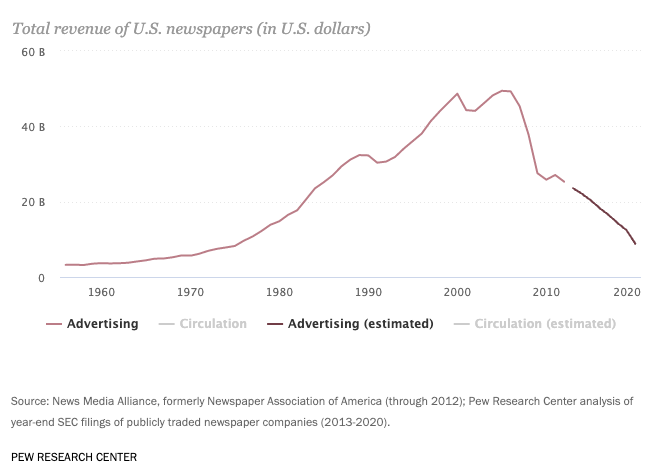
The steady decline of print and exponential growth of digital media has turned many industries on their heads. Few have been hit harder than traditional news media. The combined advertising revenues of U.S. newspapers peaked in 2006, at around $50 billion. Less than 15 years later, in 2020, they were estimated below $9 billion – an 80% drop. In that same period, the total number of newsroom employees more than halved from 75,000 to 30,000. And in 2020 something interesting happened: newspaper advertising revenue dipped below circulation revenue for the first time in recorded history.
Â
The unavoidable takeaway is that newspapers are losing the battle for ad spend. The clear winners are big tech providers. From 2008 to 2018, Facebook’s ad revenue increased by 7000%—from $764 million to $55 billion. In other words, the ad revenue of a single company is now higher than the combined ad revenue of all U.S. newspapers at their historical peak. As one local journalist interviewed by The Tow Center for Digital Journalism put it, “The advertising dollars are going away and not coming back. Google and Facebook have just eviscerated the business.â€
With these staggering numbers in mind, the prognosis for newspapers looks bleak. Can anything halt the attrition of ad spend?
Innovation hesitation
Arguably, one of the failures of traditional media has been their reticence towards adapting to new technologies. In a recent Tow Center study, researchers found a marked contrast between the way that editors and reporters use technology in their own lives and how they implement it in their work. Only a small minority of respondents (15%) had undertaken training in new tools or platforms paid for by their employers.
From the report: “half of respondents indicated low levels of interest in learning about chat apps such as WhatsApp or Facebook Messenger. Only a small minority (3.4%) are “very interested†in this technology. This comes at a surprise given that WhatsApp has two billion users around the world and Facebook Messenger reaches more than 133 million people in the U.S. and 1.3 billion globally.
Furthermore, more than four in ten respondents indicated a low level of interest for learning more about tools such as automation. This seems to be a particularly egregious oversight given that automation is one of the most powerful tools in big tech’s arsenal. Automation allows them to scale revenue-generating activities exponentially.
Automation education
This brings us to an age-old question: Does automation kill or create jobs? It might seem logical to assume that automating tasks removes the need for a human employee and thus contributes to a removal of jobs. In the short-term and in certain industries this may well be true.
In news media, however, it may be that the unwillingness to embrace automation has had the opposite effect. We see clearly that the number of newsroom employees has more than halved while the tech companies that have embraced automation keep growing. Editors and journalists may fear new technology. However, they should really be more concerned about the ongoing impact of relying on old technology.
One powerful way in which newspapers may find salvation in automation is in the sale of their ad inventory. Historically, newspapers established tight and long-lasting relationships with large, corporate advertisers. These relationships were maintained over lunches, cocktails, and many hours of manual work and negotiation. Think Mad Men. Of course, the Golden Age of Advertising has long since passed. Today, the name of the game is ease of access, efficiency, and iteration.
One of the reasons that companies like Facebook have been able to snatch ad revenue away from news media is that their main ad sales model is entirely automated. Although not the first to do so, Facebook set the standard for an e-commerce approach to selling advertising.
Self-serve adoption
Today, most social platforms offer some type of campaign manager inspired by the Facebook for Business marketing platform. LinkedIn, Instagram, Google, TikTok, Snapchat, and Reddit are just some of the tech companies that have fully adopted self-serve advertising as their primary model. While the phrase is beyond cliched, self-serve platforms really do cut out the middleman.
That’s not to say that the news media has entirely missed the bus on self-serve. The Washington Post, Bloomberg, The Atlantic, News Corp, New York Post, and Mail Metro Media are some of the publishers that have built or are building their own self-serve ad platforms. At present, most of them channel only a very small proportion of their ad sales through their self-serve platforms.
As the benefits of scale, speed and automation become impossible to ignore, however, I predict a wholesale self-serve revolution in the newsrooms of the world. Perhaps the age of newspaper advertising isn’t over. Rather, it is entering a promising new phase.
Â
Digital window shopping: the act of browsing an online store with no direct intention of making a purchase.
With the pandemic keeping people at home, consumers have switched from the store to the sofa. As a consequence, digital window shopping has exploded.
A recent survey found that people browse products more frequently online than in-store, while another showed that the average shopper leaves more than £100 worth of goods in online shopping baskets every month.
Online retailers are obsessed with conversion rates, and they know all too well that consumers can spend hours browsing before they make a purchase (if they ever do). But what e-retailers may not realise is that window shopping provides another incredibly lucrative opportunity: digital advertising revenue.
Demand for data
The recipe for selling ads is relatively straightforward. Impressions + user data = revenue. And online retailers, particularly fashion retailers, have both impressions and actionable user data aplenty. ASOS, for instance, rakes in around 75 million visits to their site every month, with users viewing an average of 8 pages over 6 minutes. For comparison, a leading news website like the BBC has an average visit time of 5 minutes and 3 pages.
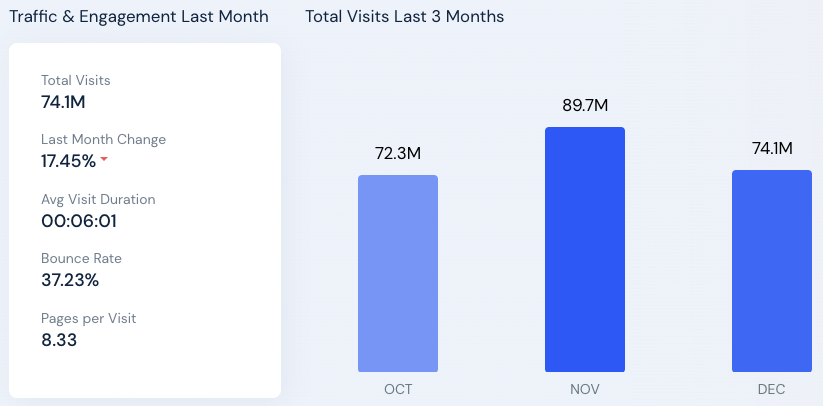
While a digital fashion retailer that only sells its own products (think H&M’s webshop) has little incentive for their users to click ads that direct them away from the storefront, retailers who represent multiple brands (such as ASOS or Zalando) are well-positioned to take advantage.Â
Two profitable strategies present themselves.
Owning the supply chain
First, such retailers can create their own in-house marketing tools that allow their partner brands to promote their products within the platform. That ensures a) brand-safety and relevance and b) that users clicking on ads remain on the website. This is the digital equivalent of in-store advertising, as practiced for decades by grocers and supermarkets.Â
The second strategy is to sell ad space to the open market. While the drawback is that users will be relocated away from the retailer’s own website, this is more than compensated for by the potential revenue generated by the massive digital ads market. Ad space could be sold programmatically, and complemented with a brand-owned self-serve campaign platform.Â
Relevance = Conversion
One of the most powerful features of a brand-owned ads platform is that by ensuring higher ads relevance, conversion rates are typically much higher than industry averages. That allows the retailer in question to charge a premium rate, because both the quality and quantity of clicks and impressions are high.Â
Digital fashion retailers should consider whether the impressions and data they sit on could be their next massive source of revenue. As reported by AdExchanger:Â these days, everyone’s starting an ads business.Â
DanAds CMO Lisen Zethraeus comments on the news publisher lawsuit against Facebook and Google.
On December 8th, Axios revealed that more than 200 newspapers across the USA have filed antitrust lawsuits against Google and Facebook in the past year. They allege that the two tech giants monopolized the digital ad market for revenue that would otherwise go to local news. The News Media Alliance, a trade group that represents newspapers, has expressed their full support for the litigation. In a recent interview with the Wall Street Journal, one of the litigants said “we felt the political and legal climate have moved in our favor and are ready to go ahead.”
Whether the lawsuits prove successful remains to be seen. Either way, their filing demonstrates “yet again” that the tide appears to be turning on the tech monopoly and its fraught relationship with publishers – especially in the news media. While the aforementioned publishers have taken the fight to Facebook and Google via the courts, others have chosen to meet them on the battleground of advertising.
One of the persistent grievances that news publishers have against Facebook is that Facebook generates an astonishing amount of advertising revenue – literally hundreds of billions of dollars – while not actually producing any original content themselves. News stories, provided by publishers, generate a huge amount of engagement and impressions on Facebook, which Facebook then monetizes through their ads business.
A 2020 Pew Research study found that the news industry’s ad revenues dropped by 62 percent over the past decade, from $37.8 billion in 2008 to $14.3 billion in 2018. From 2009 to 2018, Facebook’s advertising revenue went from $764 million to $55 billion.
Now the publishers themselves want in on the lucrative business of digital advertising, to the point that papers like The Washington Post have launched their own self-serve ad platforms, inspired by the success of Google and Facebook’s campaign managers. The Washington Post’s platform gives access to not only their ad inventory but also that of a network of regional partner papers from across the country. The New York Post, Bloomberg, and Hearst Magazines (owner of Cosmopolitan and Men’s Health) have also created self-serve ad solutions as a way of wresting back some control over their ad revenues.
Fundamentally, publishers are tired of the status quo. The slow death of print led many to see the tech companies as their saviours, so they shifted their focus from subscriptions to ads. But the last 10 years have seen those ad revenues diminish – even as the reach of the media has grown and grown.
The relationship between media and tech providers is closer and yet more contentious than ever before. Both are dependent on each other, but for years Big Tech has had the upper hand. As publishers start owning their ad revenues, they move towards a more even playing field – which benefits everyone.
It has been a tumultuous year for publishers and brands in the world of digital advertising. Facebook suffered several blowbacks from a much-publicised whistleblower to a sustained global services outage. At the same time, public and regulatory pressure mounted on many of the tracking tools long considered essential to advertising online. In June, Google indicated that they were slowing down their timeline for phasing out support for third-party cookies, but that the cookie’s demise remains inevitable. Trade articles, marketing events and conferences too numerous to count have debated and discussed the cookie-less future all year long.
Four advertising trends in particular have defined 2021 and the evolving needs and concerns of publishers and advertisers alike.
1. First-party data to the fore
2. Brand safety more crucial than ever
3. SMEs can no longer be ignored
4. Innovation in creative formats
Let us explore these trends one-by-one.
Beyond third-party cookies
With the impending obsolescence of the third-party cookie, interest in first-party data has grown significantly. Consumer privacy expectations, GDPR and ePrivacy regulations, and web browsers blocking third-party cookies are all factors driving the shift. At the start of the year, the Forbes Technology Council predicted that “First-Party Data Will Reign Supreme For Marketers In 2021”. Indeed, major digital platforms and publishers invested heavily in their native ad systems this year. TikTok, for instance, launched four new advertising and ecommerce formats in September. Two months later Snapchat followed suit, releasing their ‘Multiple Formats Ad Set’ to advertisers. Building solidly on first-party data, these self-serve ad platforms demonstrate the growing value of in-app and platform-based advertising.
Contextual targeting is another approach finding favour. A great example is The Washington Post, which launched a self-serve ad platform earlier this year, where ads are based entirely on the context of the news piece (rather than user data), and offered on a network of multiple news publishers. A broader range of options for advertisers and marketers shows promise for a more democratised ad market, with some healthy competition for the tech giants Google and Facebook – whose dominance has come under increasing scrutiny this year.
Brand safety
There is no doubt that consumers are more sensitive than ever to brand messaging. The highly-politicised nature of social media, particularly Twitter, has made brands more aware and more cautious about the context in which their adverts appear. Despite that, they’re not necessarily getting any better at preventing brand contamination. One report suggested that two-thirds of the UK’s top 100 advertisers were exposed to potentially unsafe brand environments. A separate study from Reuters reported that 77% of consumers believe that “advertising next to ‘unsavoury or objectionable’ stories can damage their perception of a brandâ€.
A key concern is therefore the amount of control the publisher has over the adverts that appear on their platform. For advertisers, they need to know which publishers their ads are purchased from. The problem is that the dominant method of digital ad sales, programmatic, makes no such promises. The “black box” of programmatic, while effective at driving down prices, is infamously lacking in transparency on these issues and more. Thus it’s no surprise to see more and more publishers and advertisers turning to brand-safe self-serve environments.
SMEs fuelling ad spend growth
Most of Facebook’s substantial ad revenue ($69.7 billion in 2019) comes from SMEs, rather than large corporate clients. Indeed, the highest-spending 100 brands (out of 8 million advertisers) account for only about 6% of the platform’s ad revenue. For publishers who have long been preoccupied with their larger corporate clients, the SME market is becoming an attractive prospect. Smart publishers are waking up to the potential of serving long-tail advertisers (SMEs) with scalable solutions – as well they should. SME digital advertisers are on the rise. In 2021 social media was the most popular advertising channel for small businesses, and more than a third of SMEs plan to increase their video advertising efforts. Nearly a quarter plan to reduce their investment in print advertising.
Ad format innovation
As consumer media habits evolve, so too must ad formats. As streaming TV continues to demonstrate rapid growth, the opportunity to improve upon classic television ad-break formats emerges. One example: the simple but highly effective pause-screen ad format, popularised by Hulu. While the old school of thought favours aggressive advertising that grabs our attention, sometimes subtlety is the better strategy. In fact, everyday we are served adverts that we likely don’t even recognise as promotional material, and find far less disruptive to our day-to-day activities.
Much like streaming TV, the world of music streaming is quickly adapting with new and less invasive ad formats. Spotify and SoundCloud have both embraced the power of seamless, non-disruptive, integrated advertising. An example: SoundCloud Promote is an advertising platform that the company uses to sell platform-localised promotions to artists. Premium users can promote their tracks to target audiences on the platform so that they appear on the listener’s feed as recommended songs. Why does this work? Because it’s up to the listener to decide if they want to listen to the song or not – and perhaps counterintuitively, this more laissez-faire approach results in much higher engagement rates than traditional interruptive ads. Advertisers and publishers should keep an open mind towards the importance of the user experience when designing or choosing their ad formats.
Last words
Change is the only constant. The digital advertising world continues to evolve at pace.