
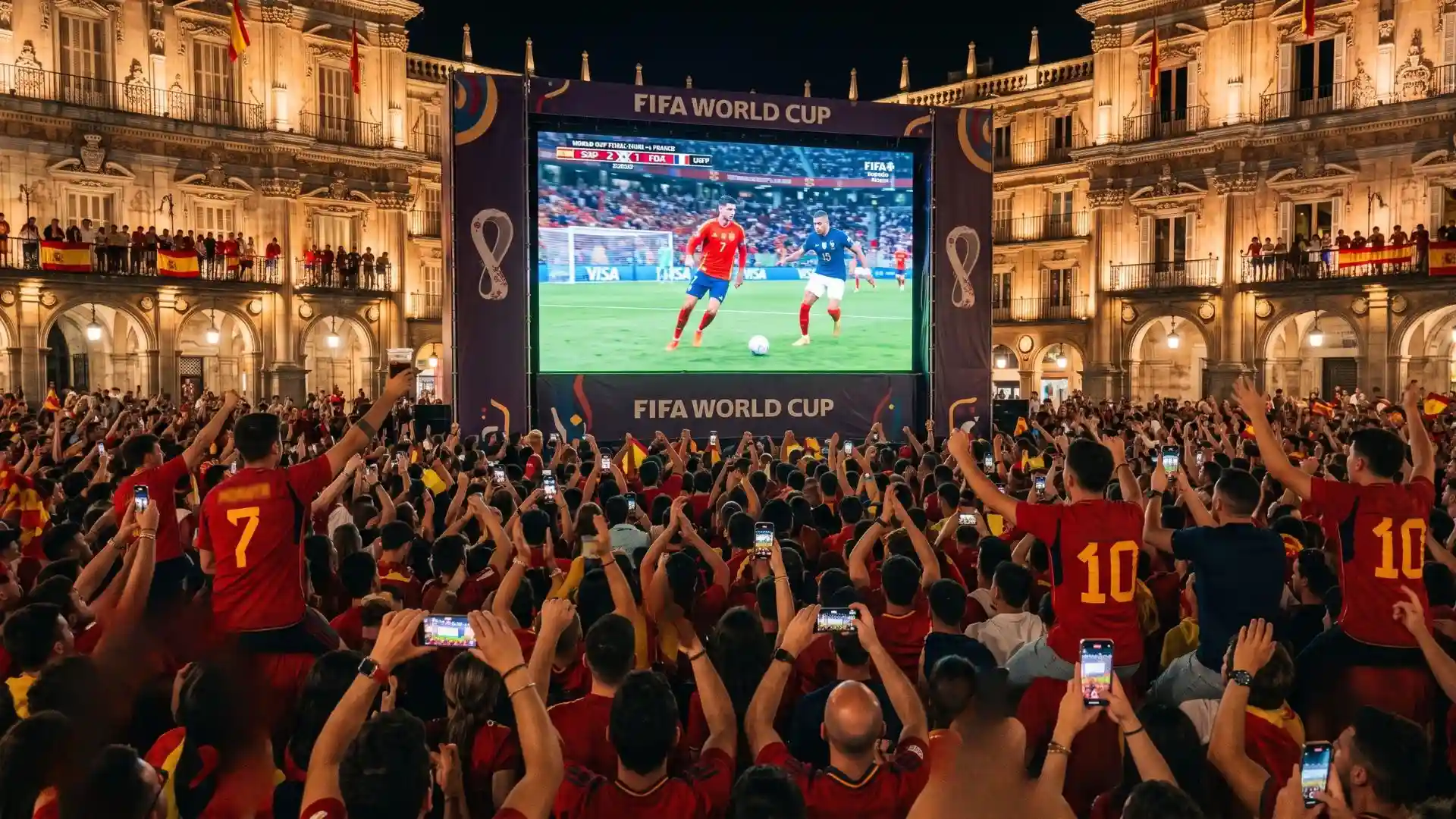
With the semifinals kicking off this week and the final just a few days away on July 19, the FIFA World Cup 2026 has moved past forecasts and into results. WARC projected the tournament would add $10.5 billion to global ad spend, across 104 matches watched by 6 billion-plus viewers worldwide.
But let’s be honest: this tournament was never just a sporting competition. It has fast become the biggest monetization moment in broadcast history. Now that most of the matches are behind us, we can finally check those massive pre-tournament forecasts against what actually happened on the screens.
As it turns out, the most interesting story isn’t the sheer size of the final ad budget. It’s exactly where that money went, and how fast it had to move to get there.
The four-quarter game nobody planned for
One simple rule change did more to reshape the ad opportunity than any single sponsorship deal: FIFA’s mandatory three-minute hydration breaks, built into all 104 matches, effectively turned soccer into a four-quarter sport. That created mid-match commercial windows inside live CTV streams that simply didn’t exist in past tournaments, and the pricing shows it. Hydration-break placements have been trading between $65 USD and $100 USD, sitting comfortably inside a broader streaming CPM range of $60 USD to $120 USD for World Cup inventory. To put that in perspective, that’s double or even triple the cost of standard streaming ads!
For publishers, the real challenge and opportunity lay in the fact that these valuable windows appeared in real time as the action unfolded on the pitch, rather than as pre-sold packages locked months in advance. Managing this kind of premium, in-flight inventory required a shift toward agile, real-time campaign optimization, heavily rewarding the platforms that could automatically package and sell these moments while the game was still being played.
The forecast held up. The action moved to streaming.
Those CPMs aren’t hypothetical anymore. They’re what buyers have actually been paying, in-flight, as matches are being played, and the demand behind them is just as concentrated. Telemundo’s Spanish-language inventory sold out at 90%, with advertisers spending roughly double the 2022 cycle. Fox and Telemundo hold the exclusive U.S. broadcast rights across all 104 matches, while Tubi is streaming select matches for free, in 4K. In several Latin American markets, programmatic CPMs for display, video, and CTV have run three to four times higher than pre-tournament levels. None of this is evenly distributed. It’s concentrated wherever publishers build the infrastructure to sell it fast.
Fragmentation is the story, not the final whistle
The audience math is bigger than any single broadcast. FIFA expects total engagement across broadcast, streaming, digital, and social to reach several billion people, but the 2022 tournament already showed traditional linear TV audiences down nearly 12% versus 2018. What replaced that reach wasn’t one platform. There were dozens: TikTok as an official FIFA partner, YouTube streaming matches through media partners, and creator-led reaction and analysis content reportedly generating more total views than the live matches themselves during the last cycle.
For publishers, that means the value isn’t only in the 90 minutes. Highlight packages, match recaps, and “greatest tournament ever” retrospectives after the final on July 19 will keep pulling traffic well into August, and advertiser competition for that inventory drops fast once the trophy is lifted. Publishers who shut down their World Cup ad setup on July 20 are leaving the easiest money on the table.
What we’re seeing this World Cup confirms something we said before Milano Cortina: premium demand doesn’t wait for a sales team. Publishers that can turn on new ad formats and let advertisers self-serve ads into hydration-break slots and around the game are capturing spend that traditional, manually negotiated deals simply move too slowly to close. The World Cup didn’t create this gap. It just made it even more visible at scale.
Key takeaways for publishers
For media owners, launching a self-serve platform was never about giving up control of premium inventory. It’s about capturing revenue that moves way too fast for a manual sales cycle to keep up with. In this tournament, three things separated the publishers winning the revenue game from the ones left sitting on the bench:
1. Democratize CTV: Hydration breaks and match-adjacent content shouldn’t be a playground reserved exclusively for global sponsors. Opening up self-serve access lets regional and local brands buy into premium slots. It’s the exact same strategic play that let SMBs grab Olympic ad slots for as little as $350 USD during Paris 2024. Why let a few giants hog the field when you can invite the whole neighborhood?
2. Go live in real time: The advertisers who scored those mid-match hydration breaks booked, uploaded, and launched while the game was actually being played, not a month in advance. With group-stage packages climbing from $12 USD million to nearly $15 USD million, and remnant inventory vanishing entirely during peak moments, publishers need ad infrastructure that can say “yes” at lightning speed. If your booking process takes longer than a VAR review, you’re losing money.
3. Cut the manual ops: When booking, billing, and creative approvals run entirely on autopilot, your team is freed up to chase the next big demand surge instead of drowning in invoices from the last one. That operational agility is exactly how some platforms kept their fill rates at an all-time high, while others had to turn away late-arriving budgets simply because they couldn’t process the paperwork fast enough.
Key takeaways for advertisers
1. Extend the attribution window.
Don’t measure World Cup campaigns the same way you measure a typical same-day.
A fan who sees your ad during a hydration break often doesn’t buy right away. They pick up their phone later that day, order through a retail media app, or visit your site two or three days after the match.
If your reporting window closes too early, that purchase never gets credited to the campaign that drove it. Set your attribution window to at least 5-7 days post-match, and check retail media and app conversions separately from web last-click, so you’re not underselling what the campaign actually did.
2. Budget for the content around the matches, not just the sponsorship badge.
Official FIFA sponsorship gets you inside the stadium and the broadcast, but it’s not the only way to reach World Cup audiences.
Non-sponsors can’t use FIFA branding or footage, but they can still buy into reaction videos, player interviews, and pre/post-match analysis, content that sits entirely outside FIFA’s restricted commercial zones and often pulls in as much viewership as the matches themselves.
If you’re not an official sponsor, don’t try to compete for the same restricted inventory; redirect that budget toward creator and publisher content built around the tournament instead, where you can advertise freely and often more cheaply than in official broadcast slots.
3. Plan around time zones deliberately. With matches spread across U.S., Canadian, and Mexican kickoff times, large audience segments in Europe, the Middle East, and Asia are watching highlights and next-day catch-up content rather than live streams. That shifts real budget toward on-demand and shoulder-content inventory.
Looking ahead to the final
The final whistle blows on July 19. The monetization playbook this tournament wrote doesn’t end with it.
Sports advertising used to mean buying one big broadcast moment and hoping it paid off.
Now it’s a multi-month, multi-screen event. The winners weren’t the biggest sponsors. They were the publishers and advertisers with the infrastructure to move as fast as live-game demand.
Want your inventory ready for the next sport or seasonal occasion?
DanAds gives publishers automated, self-serve tools to capture demand in real time, and gives advertisers of every size a way in, whatever their budget.
Let’s get you in the game. Talk to us.


